Showing posts with label Alan Moore. Show all posts

Wednesday, August 21, 2013

Grant Morrison Makes Me Respect THE KILLING JOKE Even More

I was reading Scott Tipton's COMICS 101, as I often do on Wednesdays....

Which sent me to the latest edition of Kevin Smith's FATMAN ON BATMAN podcast. The relevant section being at about 1:07:35 mark.

Says Morrison:
"That's why it's called The Killing Joke. The Joker tells the 'Killing Joke' at the end, Batman reaches out and breaks his neck, and that's why the laughter stops and the light goes out, 'cause that was the last chance at crossing that bridge."
Here's the relevant page:

I am floored by the sheer obviousness of what Morrison asserts that writer Alan Moore and artist Brian Bolland have done here. I mean, granted this is after the fact, after Morrison points it out, but it's ABSOLUTELY in line with the title of the thing, The Killing Joke, as well as the thematic arc of the story.


In brief, The Killing Joke functions as a origin of The Joker, presenting him as a two-bit, failed comedian, recruited by some hoods to aid them on a heist of the Ace Chemical plant, where our unnamed comedian used to work. The comedian, unable to secure paying comedy work, with a wife to support, and a child on the way, desperately needs the money. The criminals give him a "Red Hood" to disguise him during the crime (The Red Hood was revealed in Detective Comics #168 [Feb 1951] to be The Joker's original criminal guise). During the course of the story, his wife (and child) are killed in a bizarre bottle-warmer accident, he's forced to complete the heist despite this, and he's dumped into the famous vat of chemicals. Emerging as The Joker.

That's flashback. The contemporary story involves The Joker kidnapping Commissioner Gordon, in the process shooting his daughter Barbara (traditionally also Batgirl - but that's never mentioned in this story), taking him to a dilapidated carnival and sideshow. He tortures Gordon, shows him pictures of his maimed daughter. Stating over and over again that his goal is to drive the Commissioner insane.

The MOST relevant line for this discussion? The Joker says:
"All it takes is one bad day to reduce the sanest man alive to lunacy. That's how far the world is from where I am. Just one bad day. You had a bad day once. Am I right? I know I am. I can tell. You had a bad day and everything changed."
One. Bad. Day.

How else can you describe what Batman endures? His best friend kidnapped, beaten, tortured. His friends daughter (and possibly one of his crimefighting partners), defiled and paralyzed. All by a man who he has, repeatedly, captured and incarcerated. A man he has, repeatedly, refused to kill, either out of pity or his own moral code.

Flat out, Batman is indirectly responsible for the monster called The Joker existing in the first place. He's also repeatedly refused to permanently end his monstrous work. Now, "one bad day" later, those facts have driven him over the edge.

He kills The Joker. Flat out breaks his neck. The laughter on that page stops abruptly, because the joker is now dead, in front of the arriving police sirens. Even after Gordon had warned Batman that it had to be "by the book," to prove to The Joker that the system still worked. The Joker has finally driven his eternal opponent insane.

The Joker wins, even in death.

I've always liked The Killing Joke a whole lot. A whole, whole lot. However, I've resisted it as "the best Joker story, ever" for a lot of reasons. Frankly, I've always felt that Denny O'Neil and Neal Adam's "The Joker's Five-Way Revenge" (Batman #251 - Sept 1973), or Steve Englehart and Marshall Rogers' "The Laughing Fish" (Detective Comics #475 - Feb 1978) truly deserved that crown.

However, this re-evaluation of The Killing Joke's ending changes all that. Mainly because it becomes, literally, the ULTIMATE Batman/Joker story. There can be no more. It's also a deeply unsettling and twisted tale, as all Joker stories should be.

It also makes The Killing Joke EXPLICITLY outside of continuity. Which is the grandest thing of all. Even at 17, when the book was originally published, I felt like what Moore and Bolland had crafted should not, in any way, be tied to the regular books. When Barbara Gordon was suddenly confined to a wheelchair in the regular Batman and Detective Comics monthlies, I felt that The Killing Joke had been cheapened.

I've read a few attempts to debunk Morrison's reading, and I find them just as flawed as those who take umbridge with Christopher Nolan's film trilogy. The fan brain seems to be unable to process the concept of "outside continuity." This obsession with determining if stories "count," or not, is just terribly problematic. There needs to be a realization that truly great stories rarely appear when they have to connect A to B, or worse (and part and parcel of the serialized fiction world) connect A right back to A over, and over, and over again.

Wednesday, February 1, 2012

More Watchmen

Apologies to anyone who doesn't know anything about the 1986-1987 comic book mini-series/graphic novel Watchmen. It's a seminal comic book work by writer Alan Moore, and artist Dave Gibbons. Along with Frank Miller's The Dark Knight Returns, it heralded a new, more adult, comic book style and readership. The characters and concepts of the series have never been revisted.

So, after a whole hell of a lot of rumors, the other shoe has dropped.

I'm sure there's going to be a ton of teeth-gnashing over this. "How DARE they do that to Alan Moore," and all that shit. The fanboy desire and ability to be offended by something is powerful and deep. I mean, even if we acknowledge that it's the "greatest graphic novel of all time..."

(which, personally, I think was bestowed mainly because it falls into the superhero genre that Fanboys are comfortable with - I'd probably pick A Contract With God, or some other Will Eisner work, Jeff Smith's Bone, or even David Mazzucchelli's Asterios Polyp, but that's me)

...it's just a comic book.

I mean, we think nothing of Superman or Spider-Man being re-interpreted. We expect Batman to have continuous adventures, at varying levels of quality, and, in fact, I'd argue it's completely out of character for Batman to just quit fighting crime. These characters, superheroes, are from the pulp, serialized fiction tradition, a tradition that Moore lifted from liberally in crafting the original story. Hell, almost every, single Watchmen character has elements taken from the characters DC Comics bought from Charlton Comics, and were intended to be the original stars of the series. Moore didn't create in a vacuum.

All that said, you are dicking around with what is widely regarded as the greatest superhero story of all time. It's almost a no-win situation for everyone working on this project, except DC Comics, as a publisher. The books will sell, without a doubt, even if it's just so the fanboys can grouse about "spending $3.99 for that!"

(Oh, for damn sure these will be at the highest possible price point.)

The creators involved, however? Man, even if they have a good idea, and it's executed perfectly, it'll read as a disappointment. Even a "great" comic will be going up against an original that's "genius." If they ape the style of the original, they'll be crucified for not being original. If they aggressively set out on a different path, they'll be crucified for not respecting the original work. That's a shitstorm of expectations and fears to navigate.

The good news is that DC came up with a pretty damn fine team to take a stab at it. There are people involved who's work I will ALWAYS buy.
  • Rorschach by Brian Azzarello and Lee Bermejo
  • The Comedian by Brian Azzarello and JG Jones
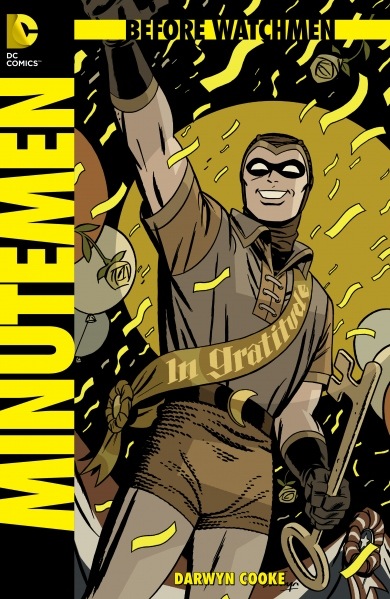
  • Minutemen by Darwyn Cooke 
  • Silk Spectre by Darwyn Cooke and Amanda Conner 
  • Doctor Manhattan by J Michael Straczynski and Adam Hughes 
  • Nite Owl by Joe Michael Strazynski, Andy Kubert and Joe Kubert
  • Ozymandias by Len Wein and Jae Lee.
  • There will also be a single issue, Before Watchmen: Epilogue, featuring the work of various writers and artists, and a Crimson Corsair (a Pirate tale that will also be a back-up feature in the other titles) story by Len Wein and John Higgins.
Darwyn Cooke and Amanda Conner are on my "favorite comics artists working right now" list. So, Minutemen and Silk Spectre will be must-reads. J Michael Straczynski runs hot and cold, for me, I'll buy Nite Owl, because I love the character, but Doctor Manhattan is a maybe, despite how much I like Adam Hughes art. Azzarello has proven to be consistently interesting, and I love both characters, so Rorschach and The Comedian will be likely. Ozymandias? *shrug* The Crimson Corsair stuff I could also care less about.

Ultimately, one can only speculate about what we're going to get, and how good it might be. I will say, it's a smart move to do prequels, as trying to follow Moore's original story's ending would be ridiculous, and in some cases impossible. They've also tapped the right people, I think. Cooke's sensibilities seem tailor-made for a Minutemen Story. Azzarello's dark, noir sensibilities are right in the track for Rorschach and The Comedian.

Of course, Alan Moore is not happy. Alan Moore hasn't been happy with anything involving DC comics for a very long time. Which is his right, but I begin to tire of his continual objections, which flare up, understandably, every time DC or Warner Brothers try to exploit the properties he created and published via their company. He's refused to accept payment, or credit, on the film adaptations of V for Vendetta and Watchmen.

He has a principle, and I get that. More power to him, but I also feel like his hyperbole about "draconian contracts" is a little stale. My understanding is, if DC stops printing Watchmen, it reverts to Moore and Gibbons. VERY few creators could get that kind of deal in the 80's. I'd bet a lot of creators would've loved that deal in the 80's.

At that time, the idea that a comic book would still be in print 25, or even 5, years later was unheard of. Nobody thought Watchmen would be as big as it is, they took a risk in publishing it, and, apparently, Moore's mad it wasn't JUST successful enough so that he could exploit the characters himself (even if that's just reprinting the original book), but DC wouldn't want to continue to publish it?

They paid Moore for the work, and (I believe) continue to pay him residuals, because the book was a success. They try, every time, to give Moore credit, and pay him, when the properties are exploited in other mediums, but Moore refuses. Alan Moore is not Siegal and Schuster, here.

That said, I'm not 100% sure I don't agree with Moore that this Before Watchmen project just simply shouldn't exist. Even if Cooke, JMS, and Azarello have cooked up something spectacular (I have faith that Darwyn Cooke, in particular, would not put his name on something he didn't believe in), it's highly unlikely to ever be a classic. Much like Scarlett is often nothing more than a curiosity read for fans of Gone With the Wind, Before Watchmen will probably always been seen as an attempt to exploit a property. To make more money by putting more product on the market. It makes sense, and I'm not one to begrudge anyone making a living.

However, I'm always ready to be proved wrong. I guess we'll all find out in the summer.