Showing posts with label theatre. Show all posts

Tuesday, October 13, 2015

How About a Life Update?

I've been busy.

There's tons of stuff going on in my little world. I'm still running in The Time of Your Life at The Artistic Home in Chicago for about 2 more weeks, until October 25th.


It's a lovely show, and well worth your time, even if I have a very small roll. As McCarthy the Longshoreman, I have a nice spotlight scene. It's the kind of role I call a "paratrooper job," I fly in, make my presence felt, and then fade to the woodwork. It's been a really great chance to work with Kathy Scambiaterra, who directed me in The Copperhead, which still stands as one of my proudest moments, again.

After that, like, IMMEDIATELY after that, I'm on call as an understudy with A Red Orchid Theatre in the world premiere of Brett Neveu's Pilgrim's Progress. I'm understudying Michael Shannon in one of the lead roles, under the direction of Shade Murray, whom I have worked with on The Petrified Forest at Strawdog Theatre and The Shadow Over Innsmouth with WildClaw Theatre. It's really inspiring and an honor to be in the room with all of these folks. I can't thank Shade enough for bringing me on board, and I must also thank Christa Rolf van Baale, who I go all the way back to Nebraska Theatre Caravan's A Christmas Carol tour with, for championing me, as well.

Both of these shows started rehearsal on virtually the same day, while I was still performing in Good People at RedTwist Theatre. I feel like I've been running for months, and I can't wait for a bit of a slow down. At the very least, I am looking forward to SHAVING THIS DAMN MUSTACHE OFF MY FACE on October 25th. I am aiming my life for December 13th, right now. The day on which all of my current commitments end.

I had a couple of callbacks recently that would've kept me working through the winter, but none panned out. Frankly, I've found myself unconcerned. Some time off will be good, and, as of right now, it looks like I'll be returning to RedTwist next summer. So, at least something is in the pipeline.

I'm also fairly excited that this time off will allow me to focus on music some more. I have four songs in various stages right now, "Light & Shade," "Tallahassee Bridge," "Carnal & Divine" (which was formerly "Riff") and an untitled fourth track.

"Carnal & Divine" has been receiving the most work and attention, lately. I had penned some lyrics, and finished up the music, when I realized a couple of things. One, the lyrics were terrible, my singing more so, and two, the music was pretty much in a rut. It sounded a lot like several previous tracks. I feel like I've successfully pushed myself toward some new directions. Away from using the same chord progressions over and over, and away from riffs that were feeling repetitive

So, what to do?

The answer was to scrap it all, and tear the track down to just the drums and the bassline. Right to the essential core, and start building back up as an instrumental track. The result has been very freeing. No, I'm not a shredder, I'm not going to whip out a complicated string of guitar heroics like Joe Satriani, Steve Vai or Eric Johnson, but the idea of approaching melody through the instrument, rather than my voice, was freeing.

When I combined this with the new focus on the drums and bass as a unit, with the guitar over it, I end up finding new lines to play. Where as before I was focused on a riff, to drive the song forward, while the vocals claimed the melody, now I find myself noodling, and going into new areas.

It's not going to be a mind-blowing instrumental, but I'm quite happy with how it's developing. It's not done, but getting there. I suspect that most of the new record will have vocals. "C&D" will likely be the only instrumental, but it's helping me see new avenues to explore. When you work alone, it becomes way, way to easy to find things that work, and then just keep doing it, over and over. It's a trap that can also happen if you're in AC/DC.

I also stumbled onto a photo that will likely be the cover of Volume 3, which I'm toying will calling Light & Shade. I snapped in in the waning days of summer, right in front of my office building as I left for the day. I was looking to the west, across the Y in the Chicago river. There was a foggy mist over the city, and the rays of the setting sun were catching in it.


There will be some cropping, of course. Maybe even some tinting and futzing with the color, as I did with the Uptown cover. Still, I like the picture a great deal, and find it inspiring.

....And I am in need of inspiration, not necessarily in the creative parts of my life, but the "life" parts of my life.

Along those lines, what's also lovely about some time off is that maybe I can re-connect with the good people in my life, the friends who's relationships have become far, far too distant. I am one of those people who cultivates a wide range of friends, but usually keeps a few people very close. The sad part is that those people feel further away recently. Either just by the fact that life is so damn busy, or the reality of geography.

There are events in the wings...I mean The Force Awakens will open 5 days after Pilgrim's Progress closes, and I am sure I will join a group of friends for an excursion. Cbyrd and I have long wanted to do a "trilogy day" of The Godfather, and it's sequels, with a big spaghetti dinner, and with my January free of real commitments, I think it's time to front-burner those plans. Not to mention a weekend in New Orleans in the depths of winter....

I need to re-charge.

Tuesday, October 22, 2013

Onward and Upward

Happenings in the theatre realm.

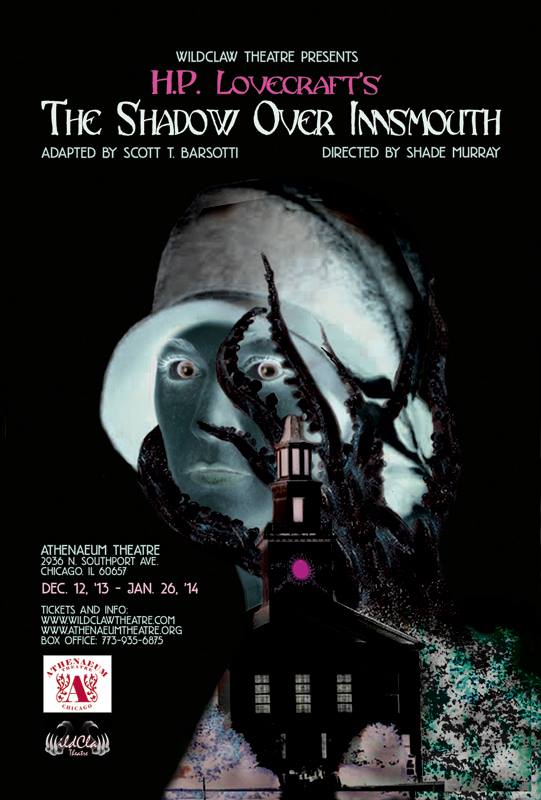
Last night marked the first rehearsal for Shadow Over Innsmouth, with WildClaw Theatre. I'm feeling pretty good about this project, seems like a decent group of folks. I've got a number of good character parts to chew into, in a horror story, which is always fun.

The director is Shade Murray, whom I worked with on The Petrified Forrest at Strawdog last year, and the adaptation of the H.P. Lovecraft novella is by Scott T. Barsotti, who wrote the lovely Your Teacher is Out Today, that I was lucky enough to be involved with during this last Summer's Leapfest X for Stage Left.

I also got word that I've been cast in a really, really exciting project for next year. I haven't got the high sign to reveal all the details, as yet, but I am beside myself with glee. When I revisited the script to prepare for the audition, it spoke to me immediately. The show, the role, I can only call a gift. A pure, true, and exciting gift. I am so looking forward to getting to work on it. I'll let you, my loyal readers, in on the details as soon as I get the go-ahead.

Honestly, I'm really thankful for these projects, because I feel like they've re-invigorated my enthusiasm for acting. Something that's been taking a beating in recent months.  This "mystery" project for next year, in particular...so, so exciting.

However, I have decided it was time to move on in certain areas. I have resigned from the ensemble of Stage Left Theatre. I still have much love for many of the fine people there, wish them well, as I hope they do for me, and will offer my support to them when they need it. That said, I felt it was time to move on, for my own good and well-being.

Time for a new chapter.

Friday, June 21, 2013

When You Think About "Success..."

Not big on God, but I like the sentiment
What does that mean?

Now, of course, because I'm me, I'm talking about people of a creative bent. I won't say "artists," because I've discussed (probably ad-nauseum) that I reject people calling themselves "artists." I'm not an artist, I'm a creator, I'm a communicator, a craftsman. The audience can decide if I'm an artist.

For a lot of people it means money, pure and simple. That they will do anything, any project, as long as a decent check is involved. The ultimate goal is to "make a living," to not have to do anything else. I get that. I really do, but I often think...what are you giving up?

If you get that major national ad gig, become the spokesman for a product, you have a really lucrative opportunity. Lots of money, lots of exposure, comfort, and some security (to a point), for as long at the campaign runs, anyway.

Yet, I keep thinking...what does that do to your career? How can you move on from that, if you've done so many ads, your face on TV every 10 minutes hocking cell phones, or whatever, who's going to want to cast you for anything else? You're the "can you hear me now?" guy forever.

I feel the same when I hear tales of people chasing gigs around the country, stuff they're not in love with, but do because they need to keep the money coming in. Again, nothing wrong with that, but...it seems to be a case of diminishing returns.

I didn't get into acting, or music, or writing, or whatever other expressive enterprise I try my hand at, to not love it. Granted, I think I would likely enjoy traveling the country performing over office work, and I did that for a (short) while. It was great. It was fun, and there was a ton of freedom to do things like surf and drink.

However, I always had my sights on Chicago, not because I could make a living acting here, but because I would watch early Steppenwolf, or Body Politic, or Red Orchid, productions and THAT was what I wanted to do, to be a part of. Work that made me uncomfortable, that challenged me, that pushed me. Even if it didn't pay me a "living wadge."

The fact is, I'm happy to work a day job when I find myself with those kinds of opportunities available to me.

Here's the truth. I am a story guy, period. I like stories about people who have problems, and try to deal with them. Who may succeed or may fail. I, personally, don't give a shit about politics, the burning issue you just NEED to get on paper, or Brechtian concepts. You can use all that stuff to tell a story, but when it overwhelms the idea of two people, standing on a stage, in conflict, I check out.

The fact is, all the fancy parlor tricks and speechifying quite often does just that. It becomes a barrier between the audience and the performer. Yes, I like realism. I like theatre that says, "these people are just like you, you can recognize them as real, not as some sort of over-baked symbol of an idea." Again, as I've trumpeted ad-nauseum, you can tell any story you want, make any point, but you have to do with people the audience relates to. What happens to these people is what illuminates your point, and often, explaining it any further is killing the catharsis.

See, because on the other side of doing everything for money, is willfully trying to make your work inscrutable.

I guess this is all prelude to the fact that I do not feel "successful." I work a lot, and sometimes it's great, and sometimes it isn't. I take jobs for all kinds of reasons, people I want to work with, companies I want to work with, even because I feel I owe somebody something (*sigh* Hero. Complex.). I strive to give my best in all cases, and I hope my colleagues recognize that.

But I live for the "magic" projects. Those are the ones that make me feel like a success, even if people hate them, even if we get the worst reviews, ever. Where the story means something to me, the character means something to me, gives me something new and interesting to play, and the people around me are supportive and working as a team. The hell of it is, it's often right after one of these "magic" projects, that I feel furthest from "success." When I realize exactly how rare they are.

That's becoming hard for me to deal with.

Friday, January 18, 2013

High Pressure

Pygmalion is open. The reviews are quite good.

Of course, what that really means to me is that I'm on to my next project. Peyton Place at CityLit. I was late into rehearsals because of my Pygmalion schedule, so this past Monday was my first night on that project. The rest of the cast had been working for about a week previous.

Hey, great, right? Come in a little late, get into the swing, feeling good.

Then I looked closely at the schedule.

I had exactly THREE (3) rehearsals before I have to be off book. Two (2) of those have already happened.


It'll be fine...it'll be fine....it'll be fine....

I hope.

Tuesday, November 6, 2012

The Delicate Balance of Dealing With Reviews

I have a very schizophrenic relationship with reviews.

I don't really hang much on them, and, as I've said, I am much more interested in the opinions of general audience members than anything else. I do believe there is often a disconnect between many critical responses, and the layman's. Not always, to be sure, but I do think that if people are flocking to see a show (or a movie, or read a book, or whatever) that is widely panned, the problem isn't necessarily the public's taste, or lack thereof.

But I do read reviews. I puzzle over them, consider any arguments I feel are valid, and dismiss any I find to be unfair or just obtuse. Sometimes, I am hurt by them, sometimes emboldened, and sometimes just downright confused. You can't change your choices because some critic for "poptheatreblog.com" thinks you yell too much, but you can consider choices you might make in the future.

I find that I learn things, even from the most negative reviews, if they come from a place of thoughtfulness. If the critic approaches the work with an openness. They may lose it completely as the show progresses, that is one-hundred percent fair, but you can always tell when that happens. There's a clarity in how they will describe where you lost them that you can learn much from.

You can also never forget that there are critics, and whole publications, who have determined, before they ever enter the theatre, if the show will be "good" or not. Is it the latest show from the current "hot" director? Is it a company who traditionally caters to an "older" audience? Is it a Neil Simon play? Or perhaps the latest "hot" playwright? You'll spot these right away. They're either gushing, embarrassingly gushing, or nitpicky about things that are, in the overall scheme, unimportant, or the best that can be accomplished on that production level, but easy to point out and mock.

That said...I absolutely reject the idea, that I have heard in many a dressing room, that critics are, essentially, a de facto arm of the theatre's promotional department. They do not owe you a good review "to encourage people to go to the theatre." They owe the public an honest, and, I believe, thoughtful, reaction to they show they saw, period.

Also, NEVER forget that it's just some person's opinion.

As you may have guessed, I am taking a walk back through reviews of Frankenstein, and my performance in it. I make no bones about the fact that I put a lot of myself into the show, and some people just did not "get" it. I tried to give everything I had, every show, and I paid the price, physically especially. So, I will admit, the first few reviews out of the gate were fairly critical, and they shook me.

At the end of the day, I think it was good. I needed to break myself out of cocoon of self-indulgence I feel like I'd started to build around myself and my performance. I was twisting myself in knots, because I wanted to be "good." I wanted to be impressive.

What this taught me is to relish when the critical reaction to my work is all over the map. When some critics dismiss your work, while others embrace it eloquently. It's a visceral reminder that not everything is for everyone, and that trying to be that is a recipe for luke-warm water.

Ultimately, the reviews were all over the map. I was honestly amused by the sheer variety of reactions. Some people wanted more rage (as if The Creature is some sort of 19th century version of The Hulk), while others seemed to feel I was just wandering around bellowing the whole time. Who knows? Perhaps my performance varied that much from night to night. Perhaps that's the curse of playing such an iconic role, everyone had their own creature in their mind before I ever rose from the slab.

It doesn't matter. It. Does. Not. Matter.

The simple fact is, the lions share of my notices were positive, if not outright glowing. I have nothing to complain about in the grand scheme. I certainly did not have to deal with some of the out-of-line comments that were directed at other members of our cast. Honest criticism is fair, comparing an actor to a Muppet is just being a dick for the sake of it.

All I know is this; I loved doing this show. I loved playing this role. I loved this cast and this script. I feel strong and justified in the choices I made and the performance I gave. Was this a perfect production? Probably not, because that simply does not exist. I wanted as many people to see it as possible, and I am honored by every person that did.

Tuesday, October 23, 2012

Argo and Sweet Bird of Youth

Hello friends. Been a while. I apologize for my lack of blog entries. Life has filled up with about a million things in the past few weeks, and I have felt somewhat overwhelmed. I'm gonna try to be more consistent moving forward.

Got to see Argo last week, and, for my money, it more than lives up to the hype. Ben Affleck has, once again, proven himself to be one of the most talented new directors in the business. He's done it by embracing (and never more so than in Argo) a 70's-style ascetic. He tells stories, and allows the art and craft to be in how well, and how economically, he tells them. I tell you, when the 70's Warner Brothers logo was used to begin this film, I was over the moon.

I'm, going forward, not going to spend a lot of time on plots here. You can easily find out the plot of Argo, if you wish to, and I (perhaps egotistically) feel that my thoughts on the subject are more interesting than rehashing the storyline. Argo is the true story of a CIA operation to rescue a small group of Americans from Iran during the hostage crisis, by disguising them as a sic-fi film crew.

The story is compelling and it's astounding that such an audacious plan was put into play. Yes, it's clear that many of the third act twists and turns are likely augmented in order to ramp up tension and build to a satisfying climax. It's not unexpected, and with the sheer quality of filmmaking on display, not unwelcome. The groundwork that is established, the reportedly very accurate early scenes, give Affleck all the room in the world to stick the landing as a truly satisfying thriller. .

The cast is terrific, top to bottom. Alan Arkin and John Goodman are clearly having the time of their lives sending up every Hollywood cliche in the book. The scenes between them and Affleck, setting up the cover story for the operation, are pure gold. Affleck, too, just nails his central role. It's not flashy, it's a quiet, contemplative performance, and a reminder of why he became a star.

The simple fact is that I loved this film, and fully expect to see it nominated for Best Picture. It just simply is a terrific, old-style Hollywood thriller smart, funny, and fulfilling. It'll keep you on the edge of your seat, and not insult your intelligence.

It's a must-see.

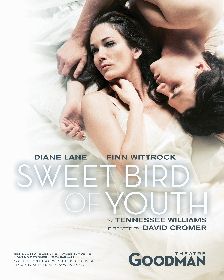
Also saw Sweet Bird of Youth at the Goodman on Sunday.

I'm a Tennessee Williams fan, but Sweet Bird is a play that has, in the main, escaped me. I don't recall ever having read or seen this show before Sunday night. So I was not overly expecting anything, except a Tennessee Williams play. On that level, it delivered, with a suitably southern charm covering a dark underbelly, and some sharp one-liners and turns of the phrase.

However, David Cromer's production didn't score completely, for me. Some of the performances are lovely, I found Diane Lane wonderfully fun (and thankfully less take-your-breath-away gorgeous than on the Goodman's poster - which seemed wrong - the character is more worn-down than the image suggested) as Princess Kosmonopolis, and most of the supporting cast was top notch.

What I didn't like was some of the technical wiz-bang that Cromer employed. I felt that many of these bold technical choices, while I admired the audacious creativity, weren't adding up to a cohesive vision. With a ginormous live projection of Ms. Lane's face as she read lines facing out a window, as well as several other characters at various times in the show. It's a choice that worked better at some points than others, but also was not used enough to feel organic to the production.

We also had a third act set that rotated, and rotated, and rotated. The set became the show, and Finn Wittrock's Chance Wayne was lost, which is really a crime because that character is the driving force of the show. The third act is about him losing control of the web of lies and tall tales he's built around himself, and finding out that he's just a gigolo. Cromer's production, it's about a big rotating set, and a camera light that occasionally blinds the audience. Chance may be losing control, the choice may be to symbolize him becoming lost, but the audience is losing him, too.

I was especially perplexed by the odd video footage of incredibly fit men diving that was projected on the curtain between the two scenes of the first act. The imagery has a strange, soft core porn feel (which makes some sense, as it's covering a sexual encounter), but the convention never returns for the rest of the show.

The less said about the moment where turning on a lamp switches the set from (apparently) broad daylight instantly to dusk, the better. I spent probably five minutes, not paying attention to what was happening on stage, but trying to figure out why that happened.

I also felt like Finn Wittrock is a fine actor in a role that I think he's not quite right for. Chance Wayne is said, in the script, to be 29. Wittrock, whatever age he actually is, looks about 24, and a very clean, beautiful 24. I found myself thinking that we should see more of the cracks in his beauty. There's a desperation in Chance's actions that doesn't seem as motivated if he's still as beautiful as Wittrock, clearly, is.

I know that Paul Newman originated this role, and that image came to me a lot (completely unfair to Wittrock, I fully admit). Newman was beautiful, but he also had rough edges, he was worn down. Perhaps the idea that it's more Chance's fear of his decline than his actual decline, but that didn't really come across, either. It's a problem that I can't really lay at Wittrock's feet, he plays the moments well, I suspect that I'd find him to be absolutely lovely in the part a few years down the road.

I was also less than enthralled with William's final speech from Chance. It's one of those moments where the playwright feels the need to have a character explain to you how you should, ultimately, feel and react to them. Always troubling for me, because it speaks of a playwright who didn't trust the actor to get the point across.

The show is worth seeing, for the performances, and a layman audience might just let the odd visual choices just wash over as spectacle. I fully admit, as a practitioner, I likely think about this stuff way too much.

Thursday, October 11, 2012

Black Watch

I was very lucky to get to see The National Theatre of Scotland's Black Watch last night. Presented at the Broadway armory by Chicago Shakespeare Theater. The show originally ran in Chicago about 18 months ago, while I was in performances of The Copperhead. I missed my chance that time around, and thankfully the production was popular enough that CST brought it back for a two week run.

Black Watch is, I guess the best description is a multimedia production, about the famed Scottish Infantry regiment, identified by the red ostrich feathers worn on their hats. It combines video, movement, and theatre into a pretty powerful presentation about the regiment's deployment in Iraq. The show also offers the history of the regiment in a very concise and entertaining way.

Now, in general, I'm sick of hearing about Iraq in theatrical productions. I'm especially sick of the liberal hand-wringing that pervades most shows that go up about Iraq. We get it, right? We get that it was wrong, we shouldn't have been there, and that is was, in many ways, a disaster. I also say that as a pretty Liberal dude.

What's lovely about Black Watch is that, really, Iraq is central, yet not terribly important, to the ultimate story being told. It could be any number of conflicts. It's a catalyst for the characters to change and develop, and that's the key. There are various political statements and overtones to the show, but the story is about these soldiers being confronted with a kind of enemy they'd never confronted before. Much hay is made that the Black Watch has fought for hundreds of year, with forces all over the globe, distinguishing themselves, but the idea of suicide bombers is unnerving and confusing to them.

This is what I truly loved about the production. It's about soldiers, and makes no excuses or condescends to those men. They are gung-ho, and remain gung-ho, for most of the play, and the ultimate change doesn't hinge on a political awakening or speechifying (though there is some conversation made around that point), but at the fact they were ought-fought by a enemy they couldn't even truly see. The political themes are clear, yet wholly subservient to the story of these men, and their experiences.

As a side note, I am truly done with any script that positions "the military" as the villain, and then offers little to no reasoning for this other than they are "the military." I have tons of gripes and arguments with politicians and bureaucrats who put these events in motion, but nothing but respect for the soldiers who have to survive, and end up doing and facing things that none of us will ever really have a clear picture of. Even if we like to sit back and click our tongues over the horrors of war. Most of us will never truly understand the horrors of war, period. These are men of honor, and the play respects that.

The show did remind me somewhat, in terms of scale, scope and style, of War Horse, but I think that show is the more solid, overall, production. The productions are both massive, and share the "boy's own adventure gone horribly wrong" feel. They also share the "less is more" aesthetic that I admire so much. Flying rigs are visible, set pieces serve multiple uses, and the scenes come alive, not through massive amounts of detail, but through the conviction of the performers. It allows such a more fluid performance. I love it.

There were things I didn't love. I felt some of the movement portions of the show went on longer than they needed to, especially since (as is utterly correct for a military-theme show) they were very regimented and repetitious. I did, on a couple of occasions, feel like they repeated a few times too many.

I also, and this is a pet peeve, I acknowledge, was not taken with the idea that writer Gregory Burke is, ostensibly, a character in the show. He, or his avatar, meets with the surviving troops in a pub after their return from duty. I didn't find this as utterly off-putting as when Moises Kaufmann and members of the Tectonic Theatre Project show up as characters in The Laramie Project (a choice that almost destroys that play for me...as opposed to the sublime Gross Indecency: The Three Trials of Oscar Wilde - but I digress), mainly because these scenes are undercut so well by the humor of the veterans he's interviewing. Again, the vivid characters trump a choice that seems, on the surface, a bit self-serving. You went out and interviewed these guys? Great! However, reminding us of your process tends to draw me out of the story...and I am a big believer that the story is everything.


Minor thing, honestly. Like I said the characters are vivid enough, and the performances rich enough with humor, that I stayed invested. It stuck out mainly, I believe, because of my own issues.

All minor gripes about a show that really is something we should all be looking at, as theatre professionals. Large scale theatre that puts storytelling and fluid performance over design detail and minutia, as well as political theatre that keeps emotional content it's primary consideration. It's top-notch, and you should try to see it.

Tuesday, October 2, 2012

The Reason We Should Be Doing Theatre.

Frankenstein has been a labor of love for me. It's a show I've thrown myself into with every bit of energy I could, it's a character I felt a deep connection to, and wanted to do justice to. I've paid for it in wear and tear on my vocal chords, and and near-constant aches and pains. It is, with no close competition, the most difficult show I have ever been involved with.

How can I tell? I've never had to take painkillers after a show before, and I hope to never have to again. My body aches, every inch of it. I feel like my arms might snap off. My head pounds with tension and strain. The act of taking off the make-up and costume is like a feat of endurance after the show.

I'll be honest and say that I've had moments where I wondered if it was worth it. Where I found myself fretting over what the reviews might say, how my peers might react to the show. Anger and resentment over not feeling I was being given the time and space I needed for my preparation. I was, and am, giving everything I can and, somewhere in the dark parts of my mind, I wanted to be hailed for it.

What a stupid, stupid way to think. What a useless mindset.

Not only that, but how hypocritical for me, the guy who constantly rails against creating theatre for other theatre people. The incestuous, deadly loop of diminishing returns and irrelevance.

As usual, some higher power always gives us the reminders we need. After our matinee on Sunday, I took my usual forty-five minutes, or so, to get out of costume and make-up, and headed down to the street. Two women were waiting near the doors of the church, and began to talk to me about how they had been in tears over the show. One of them had recently read Mary Shelly's novel, and was moved by my portrayal of the Creature. They just gushed over the show.

I was even friended on Facebook, and saw that similar comments were shared with her friends.

And it made me feel very small a petty.

Those ladies, THEY are our audience, and no matter how I may feel about "mistakes" I have made on stage, or what Mr. Cranky Critic, or whoever, may write about it. Those ladies took money out of their wallet and put it down so they could see a show, and they left moved and fulfilled. Not only that, but they made the effort to tell other people how much they loved it. How much sweeter that victory is, and how much more we should embrace and seek that feedback.

Thank you ladies.

As for my moaning and groaning about how much it hurts, I can only turn to the Boss, who (paraphrasing liberally here) said a performance should be work, and that if he isn't tired, sore and spent when he leaves the stage, it's wrong. An artist should work as hard as a factory worker. If you don't, have you really given all of yourself?

Frankenstein opens for the press tonight, and I am extremely proud of this show, it's cast and it's crew. I am honored to be playing this role, and I will give everything I can to each and every performance. Tickets available here.

Thursday, May 17, 2012

The Crash

I am at one of my "low points."

I don't really mean depression, or pain, or anything like that. I mean apathy. I mean inertia. I'm at a point where I struggle to get excited.  I struggle to generate enthusiasm. I don't know if it's exhaustion, or, yeah, maybe depression, or what.

Which, as you would probably guess, sucks. It sucks for me, and it sucks for the people I'm working with. Although, I do try to hide it, put on the brave face, soldier on, whatnot. That just makes me feel worse, because, damn it, I hate to let people down. At the end of the day, I just want something exciting to happen, and I feel like it might be a pipe dream.

It's not across the board. I'm really excited about the jam session on Saturday. That said, it's something different. I don't get to go in a room and play guitar with a rythum section often, hardly ever, honestly. It's been years.

It's the day-to-day stuff. Work. Eat. Stage Left stuff. Sleep. Rinse. Repeat. Repeat. Repeat.

Doesn't help when the little shit, installing a new DSL modem and setting the wi-fi back up, for example, becomes WAY more complicated and intensive than it ought to. Haven't we evolved to a point where this sort of thing should be (relatively) plug-and-play? Or at least provide reasonably functional and clear directions?

Don't even get me started on the bigger stuff. It trickles down, and I just...feel...shot. I feel like there's nothing in the tank. At all. So much so, that, deep down, where I don't want to look very closely, I just don't really care so much anymore. That, my friends, scares the shit out of me.

Maybe I pushed too hard for to long. The '11-'12 season has been very busy for me. Three full shows, almost back-to-back, a directing gig in there, too, and a workshop process. I have to tell you, I'm a bit worried about having taken that understudy gig over the summer, at this point.

Then I read that..and just think, "what a whiner. What a brat." This is what you wanted, you idiot.

I need something really exciting to show up on the horizon. Something that speaks to me, personally. Something to be passionate about.

Friday, April 27, 2012

I'm Sorry If I Missed Your Show

I've long talked about how one of the problems with local-level theatre is that we really aren't reaching an audience. We're reaching our families, and friends who don't happen to have to perform that night. It's a sad state that the majority of the audience for most theatre companies is....other theatre people. It's the sad side-effect of working in a, sadly, dying art form.

I have no idea who these people are.
Of course, this also leads to the usual horse trading, "oh, I can still see your show?! Give me a Postcard! Fantastic, you know MY show is opening in three weeks. Here, let me get you a postcard." There is absolutely nothing wrong with that. It's natural, and, with utter sincerity, when I say I want to see your show, I really do.

Doesn't mean I always succeed. That said, I also want you to know that I feel really bad about missing shows I want to see.  I'm not a guy who says "I'll be there" lightly.

How stylish...I don't look that good laying on my ass.
But I'm also a guy who, when he plops his ass down on the couch, doesn't want to move. It's a terrible failing I have. It's why I get up at 5:30 AM to work out. If I come home after work, and I don't have rehearsal, I'm going to watch TV, or a movie, or play a game, until I fall asleep. I'm not proud of it, but...there you are.

I hope you don't take it personally that, after I close a show, I don't really want to go near a theatre for at least two weeks. I just want to be away from it. I know it's selfish, but I am weak that way.

Then, of course, you realize that show your friend's in, that you wanted to see, well, it's closing Sunday. Or worse, closed LAST Sunday. Now you're screwed, because you've made plans for dinner and a movie with the wife on Saturday. The guilt grows, and you feel like an ass.

So, yeah, I'm sorry if I missed your show.

Monday, December 12, 2011

Bruce Norris - You May Not Want To Hear This....

I love this:
(Bruce) Norris does not believe that theatre is a particularly good catalyst for change. "There is no political value in having sensitive feelings about the world. I don't think it generates political action. You go, you watch, you say, 'That's sad,' and then you go for a steak. The best you can hope for is to make people slightly uncomfortable. At least if you take the piss out of the audience, they feel they are being addressed," he argues.
SOURCE


This man is so right. Theatre is not an agent for change. I do believe it can be an agent for understanding, and maybe Norris poo-poos that too easily. Understanding can lead to change, in the right context. I also, strongly, believe it can impart moral lessons, as all storytelling can, but moral lessons are not political statements.

Oh, I know, everyone thinks their own, personal, politics always carry the moral high ground. Here's the difference, morals are personal, politics are institutional. Morals are emotional, politics are intellectual.

Lectures are intellectual, stories are emotional. Please, people, stop writing plays that are political manifestos first, and storytelling second...because nobody gives a shit.

Seriously, nobody gives a shit. Oh sure, the people who agree with you will rally around you, slap you on the back and tell you how brave you are. Here's the secret...you're not brave, you're just another part of the problem.

And what is the problem?

We've worked ourselves into a corner because we've allowed ourselves to become awash in trying to give our work "meaning." We've got tons of kids coming out of theatre school, all pumped up with their desire to re-make the world into a liberal utopia, having been fed that they can do this by doing what they love. How happy and easy it all sounds! I don't have to protest, or run for office, or collect signatures, or do any of that icky work. Yes, you can CHANGE THE WORLD with theatre!!!

No you can't. Sorry to break it to you.

Just a joke...OK, Picard fans?
One of the biggest reasons you can't is because in the last century we have all but given up our place as actual, honest-to-god entertainers in favor of trying to be educators. No one cares about theatre except the people making it. Year after year, production after production, we've receded further and further from making emotional connections in favor of trotting out facts, figures and heavy-handed, blindingly obvious arguments. We've lost our way as storytellers so completely that theatre of a serious bent, as opposed to the cotton-candy bullshit of the Broadway musical, is reduced to lecture.

Research is important, facts are important, but, ultimately, useless for storytelling.

"There are 213,000 victims of sexual assault each year! A sexual assault occurs every 2 minutes!!! DOESN'T THAT MAKE YOU ANGRY!!?!!?"

Well, if you want me to be honest, no. It doesn't. The reason is simple, too. It's just a number. Why don't you, instead of waving numbers in my face, tell me story about a rape victim? Someone who's just living, and trying to deal with the results of what's happened. Why don't you eject the "concerned rape councilor" character, who's a crutch for you to inject facts and figures, which, ultimately, are a billion times less interesting and important than just writing a damaged character honestly, and letting an actor play it honestly.

People, also, do not talk like that.

Well, some people do, but NOBODY WANTS TO HAVE A CONVERSATION WITH THEM. Let alone watch them on stage. They may have to, and there's some drama to be mined in that. The drama however would be in the fact that THESE PEOPLE ARE INSUFFERABLE.

A few years ago, I directed a production of Stop Kiss by Diana Son. I love that play, and I think it's genius. It's wonderfully aggressive about not being profound. It's not about gay bashing, or homosexual awakening, it's about two people falling in love, who happen to be women, and something terrible happens to them. The fact is, that story makes more of an impact because Son just refuses to write a "gay play," but creates characters who act and feel real. Normal people in extraordinary circumstances, who are too busy dealing with their situation to even think about what it means to other people, let alone speaking it out loud.

Stop writing about ideas. Write about people.

Tuesday, June 7, 2011

London Theatre 2011 - Part 3 - Pygmalion

The third evening of theatre we took in was Pygmalion at the Garrick Theatre.

I have fond memories of The Garrick, as this is the theatre where I saw my first West End production in 2007, Treats with Billie Piper. That show knocked my socks off, mainly because I knew nothing about what I was going to see before I sat down. I would still love to work on that script, in some capacity.

Anyway...

Pygmalion was a bit of a similar situation. Of course, I know the play, but I confess I have never seen a production. I've also not read the script since college. I, like most people, am probably far more familiar with the musical version My Fair Lady.

That's a damn shame, but we'll get to that in a minute.

The idea of Everett as Henry Higgins was intriguing, as was seeing Dame Diana Rigg live and in person. Yes, I'm one of the generation at least partially led to sexual awakening by Emma Peel on The Avengers. Otherwise, I went in with a bit of a blank slate.

What I got was a nice black comedy with a bit of a mean streak. A much more interesting take on the subject that My Fair Lady will ever provide. I can't help it, people start singing, and I start to zone out on character and relationships. It becomes pretty things being paraded around the stage, and I think My Fair Lady is exceptionally guilty, especially when this source material is so rich.

Again, I think most people who might take the time to read this probably know the plot of this play, so I'm not going to trudge back over it. Suffice to say that I think the questions this play raises about women, men and identity are still very, very valid. The show felt very fresh.

Everett is perhaps a bit too dour. I've just read a review that compared his first interest to the appearance of Jack the Ripper. I wouldn't go that far, but I think that he might've allowed Higgins to enjoy his experiment, and the presence of Eliza, a bit more. The show seems to want to spin Higgins as an overgrown man-child, and that's as valid a take as any, but I think a man-child would enjoy things a bit more.

That said, the man is wonderful with the turn of a phrase, and enjoyed great chemistry with Peter Eyre as Colonel Pickering.

Dame Rigg, however was able to tap into that childish joy and glee with Mrs. Higgins. the show took an upswing every time she entered the scene. A wonderful character, well rendered.

But, really, I will save my highest praise for Kara Tointon, a British soap star (EastEnders) making her West End debut. For an actress with very few listed stage credits, she KILLED as Eliza Doolittle. She hits all of the comic beats, from the street urchin flower girl, to the almost robotic "trained" Eliza that first appears, and then nails the emotional wallop of the ending. I have her to thank for the fact I may not be able to hear someone say "how do you do" again, without laughing. Kudos for an excellent performance from a stage newcomer.

It was also nice, as we moved toward the climax of the show, my mind sticking in elements form My fair Lady, that Pygmalion takes a much darker, and interesting turn. I loved it, and I think I may be outright annoyed with the changes made for the musical. What Bernard Shaw gives us is a story about the true dangers of reshaping and playing with human beings, instead of a simple romantic comedy. When Eliza takes her life into her own hands, and asserts herself, it's an ending that brings the point home, rather than undercutting it with a weakened romantic denouement.

Nice production of a show that I should've paid more attention to before now.

Friday, June 3, 2011

London Theatre 2011 - Part 2 - Much Ado About Nothing

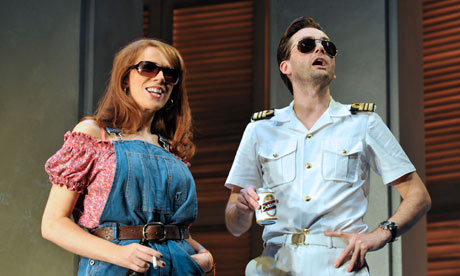
So, before we ever left on the trip, I found out that David Tennant and Catherine Tate would be opening a new production of Much Ado About Nothing in the West End. Being large Doctor Who fans, especially of the 4th season of the revived version of the show, which co-starred Tennant and Tate, we actually booked seats for a preview before we even left. I want to make it very clear, we saw a preview performance.

One of the things that I really admire about Brits, in terms of their approach to Shakespeare, is that they seem to remember that The Bard was a populist playwright. He wrote for the masses, and was never, ever afraid to go for the lowest-common-denominator. It's especially true of his comedies.

For me, too many American productions just get mired in their own importance. Tied up in the literary aspects, instead of just putting on a good show. Hell, the Shakespeare comedies are filled with asides to the audience that border on stand-up.

This production grabs hold of that element fiercely. The script is edited pretty severely, and the staging and production decisions are all pretty broad. The show wants you to leave feeling entertained, and will go to great lengths to get there.

The show is set in the 80's, with the soldiers under Don Pedro stopping off at Gibraltar on their way back from combat in the Falklands. I found the copious notes in the program about both the 80's and Gibraltar kinda ridiculous. It was plainly clear the time period was chosen because of the amusing costuming possibilities, both during the costume party (Darth Vader, Indy Jones, Werewolf Michael Jackson, and Princess Leia all appear), and the rest of the show. It's a fair choice to make, amusing almost to a fault, but really...trying to say that something organic within the text brought director Josie Rourke to say, "this MUST be set in the 80's!!" is pushing it.

It's a star-casting show. That's just fact. This production likely exists because Tennant and Tate wanted to do it. (Although, I was also amused that in the rehearsal photos in the program, Tennant is nowhere to be found.) The cast, the whole show, is built around these two actors.

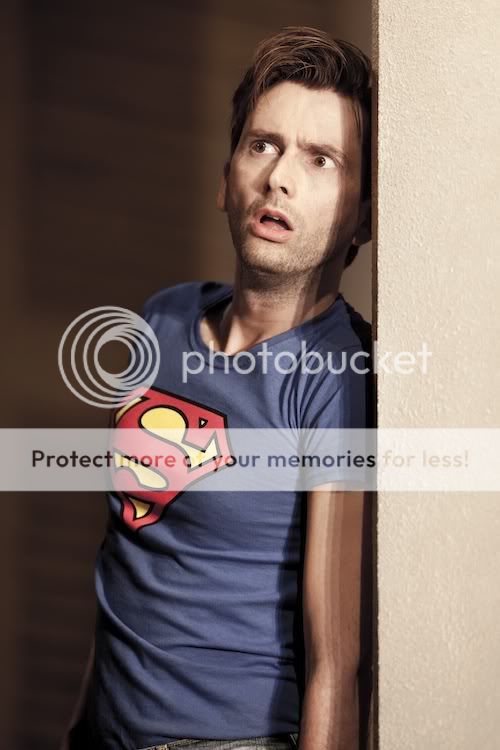
Tennant is the more experienced stage actor. I don't think that's any secret, and it shows. The show trades mightily on slapstick (which is more than appropriate within Shakespeare, as far as I'm concerned). There is a sharpness and cleanness to how Tennant executed all of these gags that is just awesomely winning. Act II, Scene 3, where Benedick eavesdrops on Don Pedro, Leonato and Claudio, who feed him false information about Beatrice's love for him, was a showstopping ballet of slapstick. With a rotating stage, buckets of paint (which ends up smeared all over Tennant), and a can of beer with cigarettes in it (oh, ho! SPIT TAKE!!). All while wearing a Superman shirt, less we forget who the MVP here is.

He then whips into the soliloquy that (nearly) ends that scene, and the full-on hambone that we all knew lurked within Tennant erupts. I'd guess the speech played at least twice as long than as written, simply due to David (I'm tired of writing "Tennant") playing the crowd. Oh yeah, he mugged, he pandered for laughs, and generally turned on the charm that's made him beloved by Who fans. Again, I wasn't bothered by this, as it seems to me to be well within the realms of what Shakespeare's comedies are, and playing to the groundlings. I've described the scene to others, who have been horrified at the whole idea. Your mileage may vary.

Not to say that I was completely bowled over by Mr. Tennant. I felt a bit short changed by the moment when Benedict asserts his intention to kill Claudio. (I'm writing this with the belief that most of my readership knows the story of Much Ado About Nothing...if you don't, maybe try here.) The moment fell a bit flat because I just didn't really feel Benedict was all that dangerous. I mean, in my mind, this character works best when his soldier (they all are), can act like such a lout, and be flippant about everything, because he's got nothing to prove. He can become the warrior the moment it's needed. Tennant doesn't quite get there.

Then there's Catherine Tate. Alas, she's just not as comfortable on stage as David. Her timing is impeccable, but I never quite felt her make the connection to the deeper parts of Beatrice. She wasn't bad, or terrible, or anything so apocalyptic. There were moments that worked quite wonderfully, but the entire performance didn't gel in the way Tennant's did. It's really something I chalk up to experience. Tate simply hasn't been on stage as much, and there's no shame in being as good as she is, in the face of that.

There's another slapstick piece for the companion scene with Benedict, with flying harnesses and other shenanigans. It's just not as funny, and even a bit labored. Certainly not as sharply executed, which is really stunning because the Benedict scene is much, much more physically complicated. It also just wasn't as logical, with certain gags just drawing attention to themselves as gags, instead of feeling like an action any rational person would really take.

All that said, the scene where Beatrice and Benedict actually come together and profess (...kinda) their love for each other is pretty cracking. They play off each other so well, how could it not be. And Tate may not hit the bullseye directly, as other performances I've seen, but the moment when she asks him to kill Claudio did land effectively. The scene is very well paced to make the line drop like a bomb.

No one's going to call this a transcendent production of Much Ado About Nothing. It's not a show that's going to take your breath away. (Although it certainly did for the teenage girl two seats down from me, who kept muttering "I love him, I love him" from the moment David Tennant walked on stage.) However, as a fan of both these actors, it was well worth the time and money. It's a highly energized, fast paced, entertaining version of the show. It's lightweight, and, let's be honest, Much Ado is a pretty lightweight show.

Thursday, June 2, 2011

London Theatre 2011 - Part 1 - War Horse

Man, it's been a while since my regular blogging, huh? A lot has happened, not the least being a trip to Europe.

Saw three shows this trip, War Horse, Much Ado About Nothing, and Pygmalion. Comparing this run to the other two trips across the pond, it wasn't nearly as good as the Treats/Glass Menagerie/Equus year, but miles beyond the Waiting for Godot/Spring Awakening year.


We saw War Horse on Thursday night. Had to pay full price, as the show's selling so well that the TKTS booth wasn't getting tickets. So, it was a little pricey, but, damn...you get what you pay for.

I've spent a lot of time telling people about this vision of theatre that I've had. I have this idea that we can do big, expansive, epic productions if we simply allow ourselves to have faith in the imagination of our audience. That the money we spend on detailed sets and frippery is, at the end of the day, wasted. We should invest in design, and make it precise, and execute it just as precisely, but that doesn't mean we have to fill the stage with garbage that's only there to look impressive.

I love black box shows, where settings are suggested by a few well-selected set pieces. Lighting and performance encourage the audience to fill in the rest. It's pure theatre, in my mind, but it requires discipline. You have to work and think about what your show is, tear it apart, see what's absolutely necessary, and be brave enough to admit you don't need the rest.

What it does is drive your entire design process, and your choices, away from "what will impress the audience," (or, let's be honest, "the other theatre people who see the show") and to "what do we need to tell this story." If you start there, you can get as grandiose, as creative, as possible, and it won't be extraneous. It'll be a choice about the show, for the show.

I also am a big believer in focusing your script, your concept. Simplify, and not just in terms of action and character, but with emotion. I think we spend far too much fucking time trying to get the audience to think, when we can make our points far more strongly, and effectively, if we just make them feel. If you know what you want the audience to feel, you'll find that more and more of the details are just, frankly, jerking off. as I've said so many times before, theatre is entertainment, not a lecture. You'll reach your audience, interest them, if they can "feel along with" (as Harrison Ford said) the characters.

Once they care, and not on an intellectual, rational level, but in a deep-seated, primal, emotional place, your points? Your deeper mission, and the "high fiber" part of theatre...it's gonna come through. It's gonna be there, and in a way that make the point personal. Your audience will fucking care about it, not because they think they ought to, but because they CARE.

This is all preamble to say that War Horse, in it's amazing glory, embodies everything I'm talking about here. It's probably the best major theatre piece I've ever seen.

Let's start with the design. Everything was functional, bits and pieces that the actors would make solid. Very early in the show, the young foal, Joey, is in a corral, with men standing around the edges as he is auctioned. The corral was there, I saw it, the men leaned on it, and it was just a bunch of sticks the actors were holding in the air. Yet the committed to it, it was a fence, a corral, and we, the audience accept that.

A door against a black area of the stage was a house.  A plow could quickly become part of the battlements. This all happened because the actors believed it, and they asked us to come along. It's so damn simple, and so few people working in this medium get it.

As the show went on, it made such wonderful use of technology I've seen elsewhere, but executed in utterly halfassed ways. Yeah, yeah, my tech instructor in college believed projections were the future of theatre, but a slide projector against a wall is just...nothing. Here we had a huge, jagged screen, mirroring a sheet ripped from a sketchpad in the show, with multiple projections and a true synch with the action of the play.

Then, of course, the puppets.

It's hard to describe how effective the puppetry was.

But again, look at the horses. There's no effort made to make them seem realistic. They are fabric and visible wood framing, the expectation is that the talent on stage, and the imagination in the audience will come together to make them alive.

I have to tell you, within 20 seconds of the foal puppet entering the stage, it sneezed while grazing, and from that moment forward, I was watching living, breathing animals on stage. It was an illusion, but one that, with some effort, and precise execution and design, is within the grasp of any level theatre with a talented, inventive team.

I won't even get into the ravens, the swallows, the Goose (which may be my favorite comedy relief character in any play, ever), or the Tank...

Oh shit...the tank was terrifying, amazing.

Then there's the story. The play is based on, yes, a children's book by Michael Morpurgo. I'm sure some will scoff at such an effort for a silly story about a boy and his horse. Here's what those dullards are missing, however; this play says more, and hits harder, in terms of making you think about what going to war actually means, the why and how that puts the men (and animals) into the middle of truly terrifying battles.

Really, the choice of World War I as the setting here is so excellent. Watching the armies trying to adapt from battles where cavalry were considered unstoppable, to a war that introduced machine guns, tanks, and poison gas, is really heartbreaking.

We wrap all of this in the tale of a boy willing to give his live for that of the horse he had raised. we follow the horse, Joey, the boy, Albert, as well as a German soldier that becomes the caretaker of the animal. Each, in turn dreams of returning home, but not all will make it. It's a tale that is simple enough to enthrall, and true enough to break your heart.

I know I was weeping though much of the show.

It does my heart proud to see this show, now open in New York, as well, and selling out on a regular basis. This is great theatre, and it represents something more than the umpteenth remount of How to Succeed in Business, or the empty calories of The Addams Family, or some other such bullshit. Not only is it great theatre, but I think it's showing us the way to how to reinvent the medium and reach out to not just ourselves, but to the general audience, without selling our souls.

I want to be in a show this good. I want to direct a show this good. If you can see it, do not hesitate.


The video? Doesn't do it justice at all.

Friday, March 18, 2011

Where the Wild World of Facebook Posts Cross Wires

I was struck by two blogs/articles posted to my Facebook feed recently.

One was yet another snark-filled ramble about Spider-Man: Turn off the Dark.

In a last-ditch effort to save his floundering musical, Bono fired Taymor last week, replacing her with Roberto Aguirre-Sacasa, who mostly writes comic books, and Phil McKinley, who directs the circus for Ringling Bros. and Barnum & Bailey

(Will the new "Spider-Man" have some elephants and a clown car, I wonder?)

Well, har-de-har-har, Mr. Michael Riedel, aren't you just a CARD!

From my perspective, take your shots at Julie Taymor. She's created a (reportedly) Godawful mess based on her hubris, but, for a show that DEMANDS high-wire performance and is based on a comic-book character, who better than a circus director and a comic book writer to try to salvage something out of it?

They may fail, make no mistake, but your cheap-ass shots, Mr. Riedel, just exposes you as an elitist.

The second was this bit about the local nature of theatre.

And, while I understand what Brian Golden is getting at with his Op/Ed piece, it's also, from my viewpoint, barking up the wrong tree. It's barking up the same wrong tree Julie Taymor did with her run at Spider-Man, but in a different way. It's also the same wrong tree the entire community has been tearing at for years, and watching their audience erode, steadily.

It's not that what Mr. Golden says is wrong, it's absolutely not, but it's also inherent with the whole concept of theatre. Theatre is not a mass media, it never has been, and never will be. It's always a local art form, it always has been. It's a presentation for those people in attendance, right at that moment. The performers will never replicate it, exactly, ever again. Also, more to his point, I'd guess that 95%, or more, of theatre in the country is presented in a community, to people who live in that community, by people who live in that community.

I always feel like announcing that, as some sort of end goal, is a cop-out. It's, essentially, a classed-up way of saying "our audience is our audience." I think that's limiting, tell the right story, in the right way, and the whole world will listen. I COMPLETELY agree with the human connection element he brings up. It's why I always feel a movie, for example, is always best served in a theatre full of other people, to share the emotional responses.

But understanding that doesn't help you with programming, with picking a season, assigning a director, or casting a show. I think, I really, really think, that we, as theatre practitioners have forgotten where we came from.

Where's not cultural shaman. We're not social workers. We're storytellers. Those other things can be part of the deal, but we need to focus on our story. Let the audience decide if it's something more.

When Og got up in front of the rest of his tribe, and told the story of his hunt for the wild boar, it came down to his story, and how he told it. That's what we have to get back to, the pure joy of storytelling.

With all due respect to Mr. Golden, because I am a member of this community, and I am connected to this story, then it's a community story. We have to move beyond our ideas of what and who "our community" is, and just tell human stories. It doesn't have to be about "us," because every good story is about "us."

Brian, if you read this, maybe that was your point, and I missed it, God knows that's not the first time that's happened.

Then we turn to Taymor. Spider-Man is a universal character, with a universal story. You can't have a concept that survives almost 50 years, through multiple generations and incarnations, without having some universal appeal. So, why, in the name of God, try to glom your "Arachne," lifted from Greek myth, into it? You already have one myth, and that's exactly what it is, that you get to play with. Why overload the show with symbolism?

...especially if it's symbolism that just confuses people, and dilutes the basic, universal, human story that's already there.

Why not just TELL THE STORY?

Thursday, March 3, 2011

Ducks in a Row

it's really funny to me, after a year, plus, where I felt like I was in a pretty huge dry spell, I suddenly find myself with a calendar that's getting increasingly full. Between now and September, it's one thing after another. All good things, thank God, I feel blessed to have them all coming up.

The Copperhead will run right up to the Leapfest new play reading series for Stage Left, If anyone asks me to do their reading. Not a sure thing, that's for certain.

In the middle of all that, Cbyrd and I are off to Amsterdam and London for a week.

...And seeing David Tennant and Catherine Tate in Much Ado About Nothing at the Wyndham Theatre while we're there. Really excited that we confirmed tickets today.

yes...quite excited.

I saw Billie Piper in 2007, a show called Treats, and now I'll see the Doctor himself, as well as companion #3 (and, frankly, the one he had the most personal chemistry with). It's really nice because Tennant and Tate as Benedick and Beatrice seems right on the mark.

We've had such lovely luck with shows in London. In 2007, we saw the aforementioned Treats, as well as Equus with Daniel Radcliffe and the amazing Richard Griffiths, The Glass Menagerie with Jessica Lange, and The 39 Steps, which I'm very thankful I got to see the original production of, as I've heard the touring productions weren't that great.

That first trip was amazing, theatre-wise. I've rarely seen that many good shows in such a short space of time. Knew nothing about Treats, and now it's one of my favorite shows I've ever seen, on a pure script level (I'd still love to do it). That particular production of Menagerie just upended a ton of pre-conceived notions I had about the show. Equus was a beautiful, haunting production, Radcliffe did justice to his role, and Griffiths just floored me.

In 2009, we returned for a much shorter stay, splitting our time with Paris (much like this year with Amsterdam), but we still managed to see Waiting For Godot with Ian McKellan and Patrick Stewart, which I can honestly say was the fist time I've ever really enjoyed watching that show. Oh, I admired it as a work, but it was never fun to watch before that night.

We also saw Spring Awakening. Of which the only thing I can say is..I am too old for that show, and CByrd and I are not musical people. Hindsight being 20/20, we should've seen War Horse. When we were there I'd never heard of it, and now, after the fact, I hear all these amazing things.

I've been trolling the listings for other shows to see while we're there. So far, nothing's struck me. I'll keep you posted.

So, anyway...back to the US, and into production on The Double with Babes With Blades. That'll carry me into the Fall, and I'm already feeling a camaraderie with the team (everyone that I know in it) already. It's a really fun little play, and I think we're gonna have a great time.

Add in trying to find the time to finish up the music projects, writing, yadda, yadda, yadda...Not to mention focusing on the here and now, rather than trying to think 10 steps ahead.

I think it's gonna be a good year.

Tuesday, October 26, 2010

Sitting Here Thinking....

...And Thinking.

...And Thinking.

...And Thinking.

I really don't know what the hell to write today. It happens, I guess. Well, hell, I know it does.

I'm sure I'm not alone in wondering what my legacy will be. Not that you wonder about my legacy, but in that we all wonder about what we will leave behind. It's so funny, I have found myself, in recent years, damn near obsessed with the idea that I want to leave something behind, about leaving my mark on the world. What was my primary choice for that? Theatre. The most transitory and impermanent of all art forms. It's there, then it's gone. The script can live on, be remounted, but the actor? It's gone never to be seen again.

It's funny, but I think I'm also starting to feel it's a bit sad.

I was at a callback on Saturday, and I ended up talking to an acquaintance about a production of One Flew Over the Cuckoo's Nest that went up here in Chicago over the summer, I think, maybe late spring. She had auditioned for that production, and had contacted me about a copy of the script. I had been in the show in 2007, for Open Eye Productions.

I knew several people who, ultimately, were cast in that version of the show. People who, very strongly, encouraged me to come see it. I tried to, in every case, politely beg off. You see, I was very, very proud of what we did as a cast and company with our Cuckoo's Nest, we got some very nice notices (see above), and it's a very precious memory for me. I can watch Nicholson play it, because, well, it's Nicholson, but I don't have any need to see anyone else do it.

No, I don't feel like I own the part. It's not mine. However, my memories are mine, and I don't want to spoil them. In my heart, Anne Sheridan Smith will always be Nurse Ratched, Andy Lawfer will be Billy Bibbins, and Manny Sosa, may he rest in peace, will be Chief Bromden. The entire cast, too many to lay out here, were amazing and fun to work with, and Chris Maher, as director, made it all such a joy. It's a pure memory, and an experience that felt fulfilling personally and professionally. In my experience, that's a rare thing.

It also gave me a lot of things I wanted. Earning the role of McMurphy wasn't about my physical look, Hell, I was as tall as, or a bit taller than Manny as Bromden. I fought for it, through six glorious hours of auditions. I read, and read, and read, I didn't even know how tired I was until I was walking back to the train. When Chris called me to offer the role, I felt completely justified in my elation. I had taken what I wanted. It had also been a good, long while since I had to carry a show like that. It was a challenge, and something that I knew I could identify with. I could make it work, but I would have to work my ass off for it.

So, with all due respect, I don't really want to see your version. I'm not badmouthing it, as I didn't see it, but my experience on that set, with that cast, is something pure and golden for me. That's why I doubt I'll ever see the show again.

Then, on the other hand...it's gone. It's not coming back, there will be no remount, and Manny has left us, anyway. So, I shouldn't hold it so close as to not be open to new things.  It's fading, and certainly no one but those of us who were there in it remember it fully. I mean, I get a few "you were in that Cuckoo's Nest , weren't you?" once in a while, but the worm has turned, and that day is done.

That, I'm not at all afraid to say, makes me sad. I also know that's what this business is. Not even the biggest "hits" live on for more than a year or two, and we didn't even sell that well.

I guess it all comes back to that "I want to matter" thing. Which is horribly selfish, and I also, objectively, know that I do matter. My life is not all what I do on a stage, I have a loving wife, family, and good friends to attest. Even if it was, lots of people see my work, in any number of shows, and have a great experience. Lots of people have told me how much they enjoyed The Sound of a Yellow Flower, and that is precious to me. Any compliment is precious to me.

I also, flat out, don't believe it 70% of the time, but that's my own self-doubt in play.

It's all so transient. It becomes a game of trying to convince yourself that what you're doing matters. If we get down to brass tacks, it doesn't. In one hundred years, ain't nobody gonna remember my name, and, if they do, half of them will just talk about what a jerk I was.

So, what's the point, y'know?

Thursday, October 7, 2010

Is There Anything More Painful?

I learned this week that there is nothing more painful to read than a screwball comedy/farce that...just isn't funny. The writer needs to keep amping it up, and amping it up, because it's a farce, that's part of the deal. Once the jokes stop hitting, or worse, if they never start, it becomes a nightmare. It's like being stuck in a stopped elevator with Gilbert Gottfried.

It just keeps braying and braying, and you know the playwright must think this is funny. The set-ups make it clear they've been exposed to a Marx Brothers movie. Yet, the lack of cleverness and wit in the dialogue suggests that they didn't actually see it, but had it described to them by...someone like an economics teacher.

**SIGH**

Makes me want to pull my hair out.

I also learned that...trying to apply a style of writing associated with a certain prose writer to dramatic scripting is, in many cases, doomed to failure. Especially if the style you've chosen to emulate is...rather wordy. I'm willing to READ a speech that takes five sentences to say something that could be said in one, but I can't imagine LISTENING to it.

Yes, yes...Shakespeare. We all love Shakespeare.

You. Are. Not. Shakespeare.

Shakespeare was also an incredibly clever user of the type of stage language that was commonplace for his time. Ol' Will wasn't sitting around thinking "Screw Marlowe and his realistic patter, I'm gonna fancy this up!!!"

For one, the point gets lost in your attempts to be "lyrical." I can re-read a passage in a book that maybe I didn't quite glom onto the first time...You get no second chance on stage. The moment is past, and you're on to the next scene.

For two, TALKING about something isn't anywhere near as dramatic as watching somebody DO IT. Watching somebody talk about the implications of what some other character just talked about, even less so. Especially when you decide all your characters spend their time talking about what's going on as if it's a lab experiment they're watching. If your characters show no investment in the plot, other than as an intellectual puzzle, it's really unlikely that I, as a reader or audience, will ever give a Rocket J. Squirrel about it, or them.

Look, there are no rules in theatre. There is a writer out there that can make anything work, and work well...

Well, not an unfunny farce, that's just...DID YOU REALLY THINK THAT WAS FUNNY?!?!? Seriously, look me in the eyes and tell me you thought that was funny...Hmmm?...Yeah, I didn't think so.

Yet, again, and I've written about this before, TELL A STORY. Find an emotional hook and play it out. Let that guide you to the style you want to employ. Let the story tell you want it wants, because then the style you've chosen won't be working against you. It'll be a choice ingrained in the dramatic thrust of what you're trying to get across. If you're choosing something, on a technical level, because it'll be "challenging" or "impressive," stop...and ask if it supports the story you're telling. If it supports the emotional hook you have into the story.

That's where the answer is.

And...I cannot stress this enough....If you're gonna write a farce, make sure it's actually funny.

Tuesday, September 14, 2010

What Are Ya Gonna Do?

Things happening, things happening....THINGS HAPPENING.

Kind of a stressful few days, the whole weekend, actually. Lots of things to assess and decide upon. Decisions to be made.

We've got a few reviews that have gone up for Yellow Flower. Reaction, so far, is all over the place. The Chicago Reader loved us, Chicago Critic was generally positive, and Time Out hated us like we'd strangled a baby. Generally speaking, I'm not a whore for reviews. Take it or leave it, you job as a critic is tho give your honest opinion, so hit me with your best shot.

It's still interesting how wildly the opinions differ. I'm always struck by that, it's like a microcosm of what Gary Coleman (R.I.P.) tried to tell us, Different Strokes do move the world. I guess it's best to look at it as indicative of the idea that our critical base is an honest one. Of course, there's also those shows that are destined for a good review no matter what.

Oh, don't look at me that way, you know it's true.

Doesn't matter if it tackles a hot-button political/social issue, or it's one of the "anointed" theatre companies, there are productions that will get a pass on anything. In most cases, I don't mind. Usually it's a company that's earned it's place, or I give 'em props for finding the exact right play to do at that moment.

Anyway...My head is still swirling around a series of events that is still unfolding in my world of theatre. I'm still not quite sure how to take what's happening, or if it's something that should be welcomed, or not.

It scares me.

When I get scared of something, I always think of Metallica: Some Kind of Monster, the documentary about the chaotic events around the recording of their album St. Anger, and the rehab of frontman James Hetfield. The line, from band therapist Phil Towle, "when you're up against a fear, that's the time to move forward," always sticks out to me.

While I'm on the subject, that movie is amazing. Seriously, I think every arts organization in the world out to sit together, as a group, and watch it. It's illuminating on so many levels about how to work within a group driven by creativity and ego.

Yes, that describes every arts organization in the world.

Friday, September 10, 2010

I Have Had Three Hours of Sleep

Just couldn't fall asleep last night...

I have drank more coffee than I do in 3 normal days.

I open a show tonight.


Yes, tonight is press opening for The Sound of a Yellow Flower. I'm pretty proud of this one, folks. I think I do some good work here. It's a great cast, and an solid script. You want to check it out if you're in Chicago.

I just hope I don't pass out in the middle of it.